
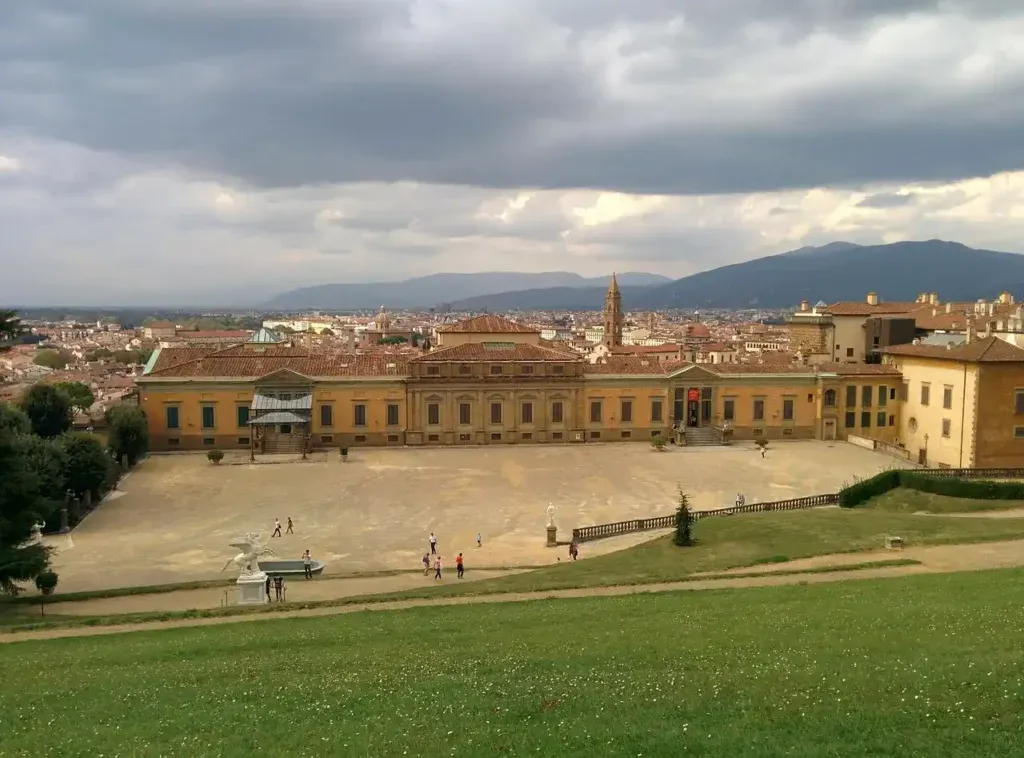
Plan your visit to Pitti Palace
Pitti Palace (Palazzo Pitti in Italian), a former Medici residence turned museum complex in Florence's Oltrarno district, holds five museums and a Renaissance garden south of the Arno River. Plan your visit to Pitti Palace around its opening hours, entrances, and visitor rules.
Information about your visit to Pitti Palace?
Pitti Palace and the Boboli Gardens open at the same hour but close on different days and at different times:
- What are the opening hours of Pitti Palace? The palace opens Tuesday to Sunday from 08:15 to 18:30, and the same schedule holds all year for the Palatine Gallery, the Royal Apartments, the Gallery of Modern Art, and the Treasury of the Grand Dukes.
- Do the Boboli Gardens close at the same time? No. The gardens also open at 08:15, but their closing time moves with the season, from 16:30 in January, February, November and December to 19:10 in June, July and August. Staff start clearing the grounds about 30 minutes before closing.
- When does the last admission happen? The palace admits its last visitors at 17:30, and the ticket office stops selling one hour before the building shuts. The Boboli Gardens cut off entry one hour before the posted closing time.
- How do visitors reach the palace on foot? Visitors walk from Piazza del Duomo in 15 minutes, down Via Roma, across the Arno by the Ponte Vecchio, then along Via de' Guicciardini into Piazza de' Pitti. Only the bridge is pedestrian-only; the rest sits inside the limited-traffic zone, where buses and taxis still pass.
- Which public transport stops nearby? The stop named Pitti sits a few meters from the entrance, served by the Autolinee Toscane C4 minibus through the Oltrarno. Line 11 stops at Piazza San Felice and Romana Boboli, both a short walk away. Santa Maria Novella station is a 20-minute walk.
- Where can drivers leave a car? Florence's limited traffic zone, the ZTL, blocks most vehicles around the palace. Garage Lungarno at Borgo S. Jacopo, 10 sits inside it, so the garage must register the plate to clear the camera; parking near Porta Romana stays outside the zone.
- Where do visitors enter Pitti Palace and the Boboli Gardens? The main entrance for both the palace and the gardens sits at Piazza de' Pitti, 1, and the gardens open through three further gates, at Porta Romana, Forte di Belvedere, and Via Romana.
- When is the best time to visit? Visitors who arrive at 08:15 or in the first hours of the afternoon miss the largest tour groups. January and February are the quietest months, after the Christmas crowds leave and before spring break starts.
- How long does a full visit take? A full pass through every section of the palace and the Boboli Gardens takes about six hours. Queues vary with the season and the time of arrival.
- Is the palace accessible for reduced mobility? Elevators and ramps connect the gallery levels, and staff lend wheelchairs without a reservation. Visitors with disabilities also get priority access at the museum entrance, though steep slopes and gravel paths make the Boboli Gardens harder to cross.
- Is there a dress code at Pitti Palace? Pitti Palace enforces no formal dress code, though the administration asks for clothing suited to the historic setting and staff turn away guests with uncovered torsos. Visitors also take off hats inside the galleries.
Explore whatever you need in detail
Pitti Palace tickets and general information
One hub page lists the ticket options for the palace, the Boboli Gardens, and the combined routes through both, along with the practical information for the whole complex.
Pitti Palace opening hours
Schedules at the palace and the gardens diverge by season, with a weekly table covering both and the dates when the complex shuts.
How to get to Pitti Palace
Florence has no metro, so visitors walk in from the center or take an Autolinee Toscane bus, with Santa Maria Novella station as the arrival point for trains.
Boboli Gardens entrances
Four gates open into the Boboli Gardens, and each one lands visitors on a different part of the slope, so the climb from one gate is steeper than from another.
Inside Pitti Palace
Five museums sit under one roof at Palazzo Pitti, spread across three floors, with the fashion collection housed in a separate wing of the building.
Where is the Pitti Palace located?
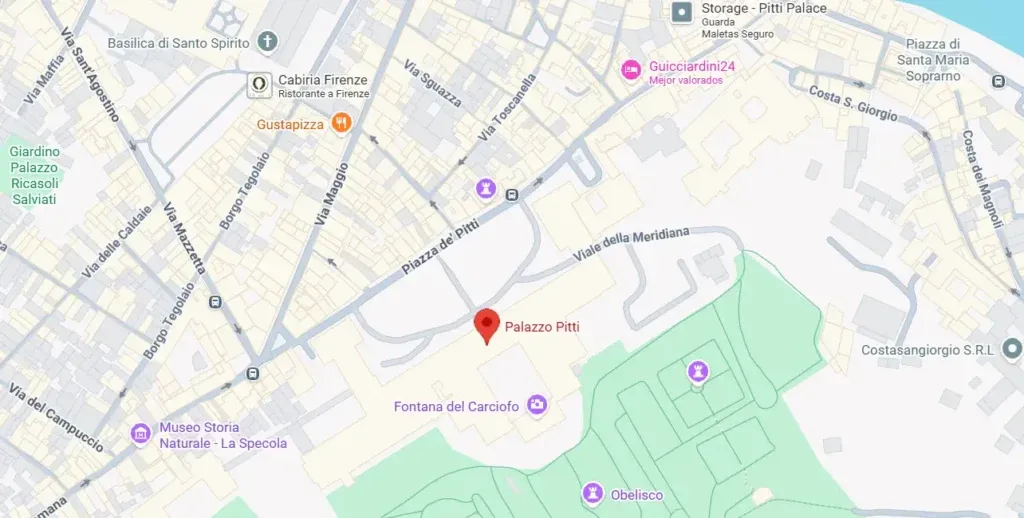
Where is the Pitti Palace located?
Palazzo Pitti sits at Piazza de' Pitti, 1, 50125 Firenze FI, Italy, in the Oltrarno, the part of Florence south of the Arno River. The same address opens into the Boboli Gardens. The Ponte Vecchio stands 500 meters away, and the Vasari Corridor runs from the palace to the Uffizi Galleries, so the main museums of central Florence sit within a short walk. A wide plaza fronts the facade designed by Luca Fancelli, and pedestrian streets from the center funnel arrivals into it. Visitors enter the palace and the gardens from that plaza.
Book your ticket to Pitti Palace
What to see at Pitti Palace
Palazzo Pitti is the largest of the Florentine palaces, a Renaissance block of 32,000 square meters on the slopes of the Boboli hill. Luca Pitti broke ground in 1458, the Medici bought the residence in 1549, and the Italian state took ownership in 1919. Five permanent museums now fill three floors: the Treasury of the Grand Dukes and the Museum of Russian Icons at ground level, the Palatine Gallery and the Royal Apartments across the piano nobile, and the Gallery of Modern Art with the Museum of Costume and Fashion above, while the Boboli Gardens climb the hill behind.
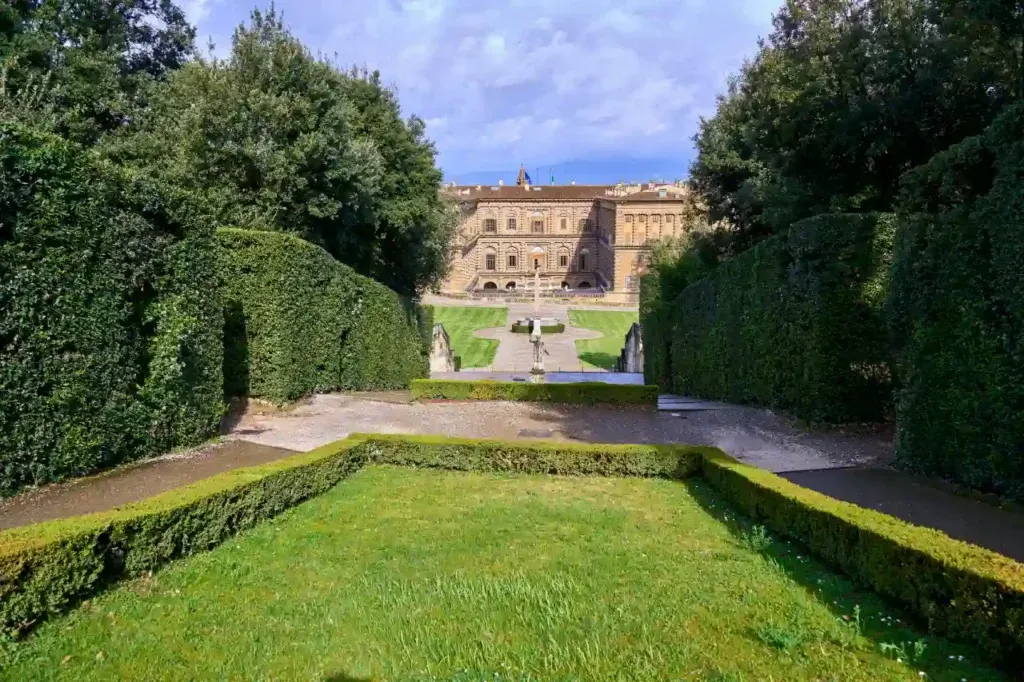
Boboli Gardens
The Medici laid out the Boboli Gardens in the sixteenth century as an open-air museum of sculpture, on 45 hectares of hillside behind Pitti Palace. Gravel paths run between stone statues and fountains, among them the Neptune Fountain and the Ocean Fountain. High stone walls and clipped hedges close the perimeter. Niccolo Pericoli, known as Tribolo, shaped the green amphitheater around 1551, and Giulio Parigi rebuilt it as an architectural ring between 1630 and 1634. Bernardo Buontalenti redesigned the three-room grotto that carries his name between 1583 and 1593, filling it with stalactites, painted reliefs, and casts of Michelangelo's Slaves. Walking the whole garden takes 90 to 120 minutes.
Palatine Gallery
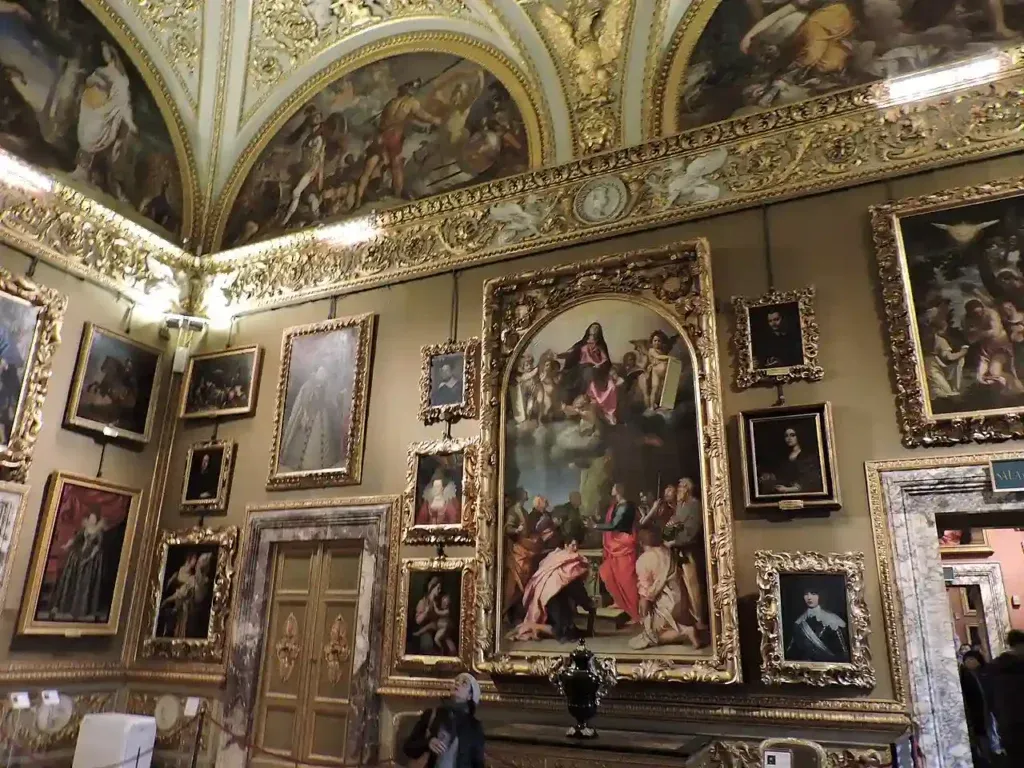
Palatine Gallery
The Palatine Gallery fills the main floor of Palazzo Pitti with about 500 paintings, hung frame against frame on silk-covered walls and stacked several levels high. The arrangement follows seventeenth-century taste rather than chronology. Eleven canvases by Raphael form the largest concentration of his work anywhere, among them the Madonna della Seggiola and La Velata, and carved frames set them beside Titian, Rubens, and Van Dyck. Pietro da Cortona frescoed the planetary ceiling cycle during the 1640s, an early case of a ceiling program planned as one scheme, and those rooms still fix the order in which visitors walk the gallery, a circuit of about 90 minutes.
Royal Apartments
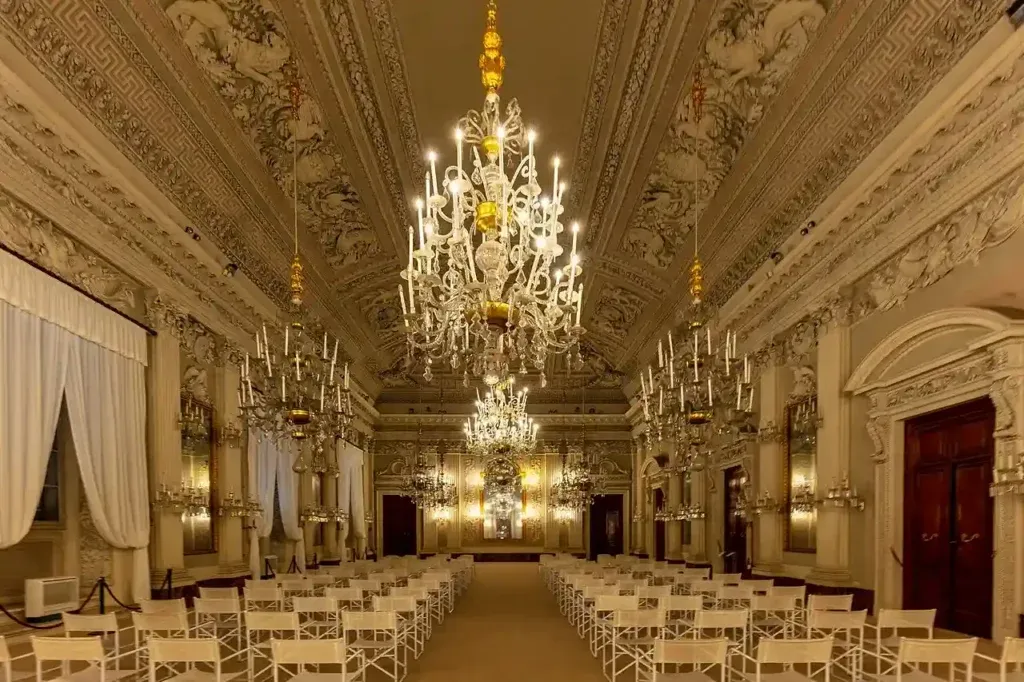
Fourteen rooms make up the Royal Apartments, which adjoin the Palatine Gallery and cover court life between the 1620s and 1919. The Medici redecorated the first series in the early Baroque, the Habsburg-Lorraine grand dukes refitted the central rooms in the late eighteenth century, and the House of Savoy adapted the last suites after 1865, when Florence was the capital of the Kingdom of Italy. Original textiles, gilded moldings, tapestries, and frescoed ceilings survive throughout, and the Audience Rooms keep their original frescoes. The Sala Bianca, a white-and-gold ballroom finished in stucco, still hosts ceremonial events, and a pass through the suite takes about 30 minutes.
Gallery of Modern Art
Gallery of Modern Art
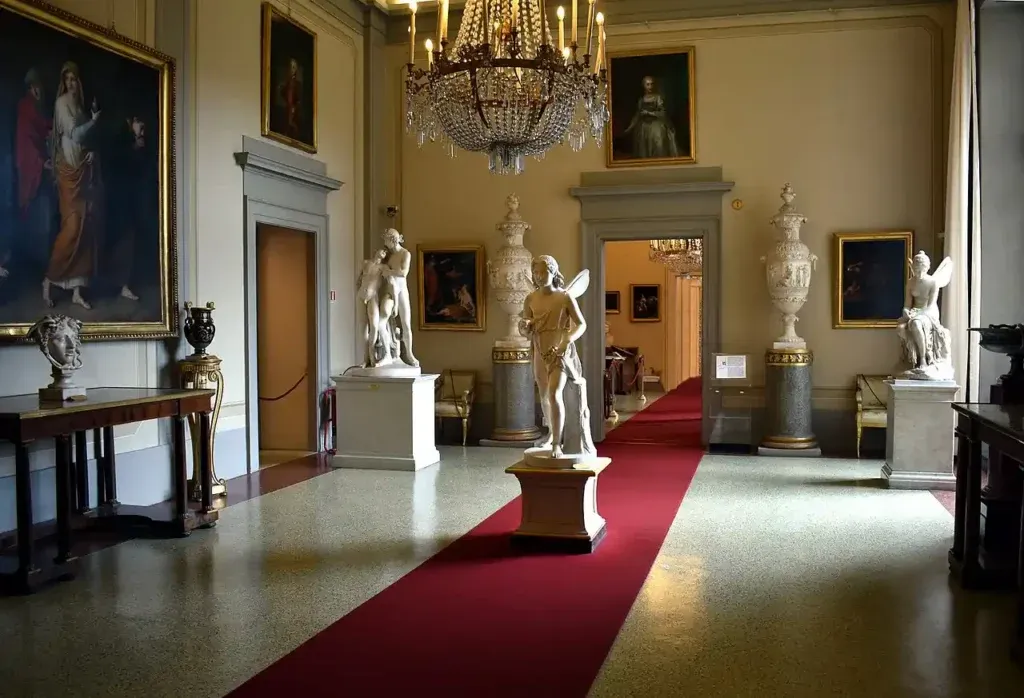
The Gallery of Modern Art occupies the second floor of Palazzo Pitti, and about thirty rooms cover Italian art from the late eighteenth century into the first decades of the twentieth. Antonio Canova's marbles open the sequence, followed by the historical canvases of Francesco Hayez. The former Lorraine apartments hold them, showing the neoclassical sculpture and landscape painting in natural light. The Macchiaioli rooms carry the collection, with Giovanni Fattori, Silvestro Lega, and Telemaco Signorini among the Tuscan painters who worked outdoors a decade before the French Impressionists. The last rooms reach the Italian vanguards of the early twentieth century, and a full pass takes 45 to 60 minutes.
Museum of Costume and Fashion
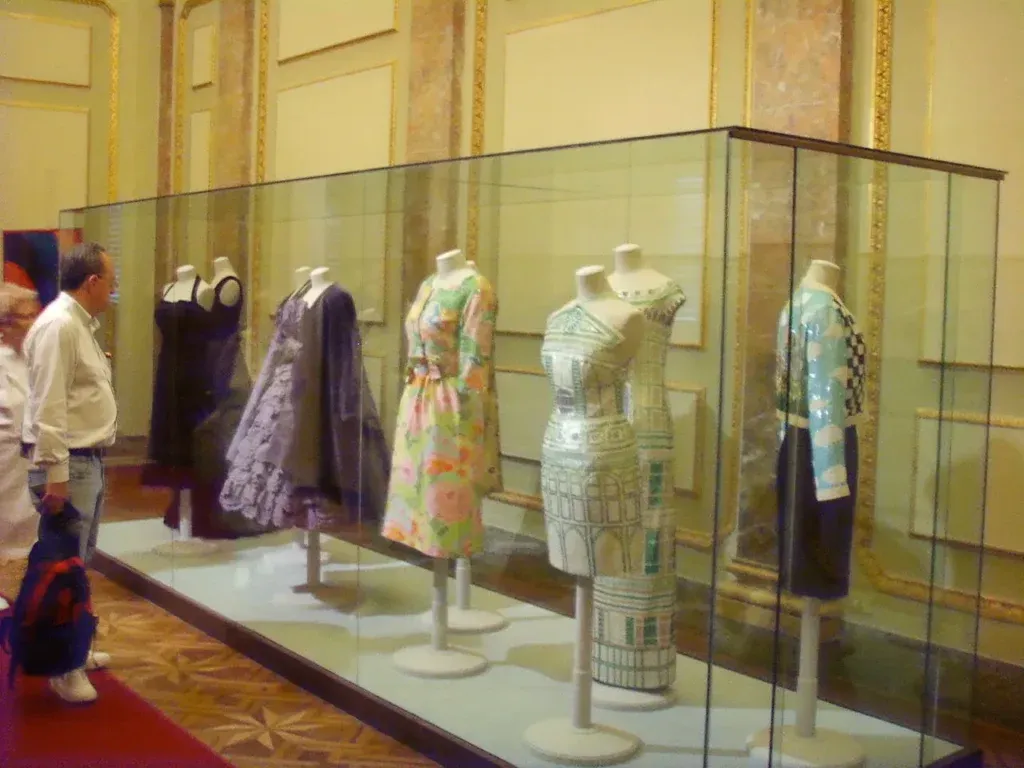
The Museum of Costume and Fashion sits in the Palazzina della Meridiana, a wing added to the main block between 1776 and 1830, and it opened in 1983 as the first Italian state institution devoted to the history of dress. More than 15,000 pieces make up the holdings, spanning the sixteenth century to the present day, including historic clothing, accessories, and theatrical costume. Curators rotate the display every two years because light damages the fabric. The sixteenth-century funeral garments of Cosimo I de' Medici, Eleanor of Toledo, and their son Don Garzia anchor the collection, and their cut and cloth marked social and political rank at the Florentine court. A visit takes 30 to 45 minutes.
Tips for visiting Pitti Palace
A visit to Pitti Palace covers three floors of galleries and a hillside garden, and staff enforce a short set of rules at the door:
- Booking online secures an entry slot, which counts most between April and October, when the complex is at its busiest.
- Comfortable or athletic shoes suit the Boboli Gardens, where gravel paths and steep slopes make formal footwear hard work.
- Visitors may take photographs without flash and without professional equipment, for personal and non-commercial use only.
- Bulky backpacks, long umbrellas, and tripods stay outside the galleries, and a cloakroom holds them during the visit.
- Nothing in the garden rules bans eating, but litter, fires, and bathing in the fountains are all prohibited.
- Pets cannot enter, except for certified guide dogs assisting visitors with disabilities.
- A cafeteria, a bookshop, nursing rooms, and restrooms sit in the basement and by the entrance on the right side of the courtyard.