
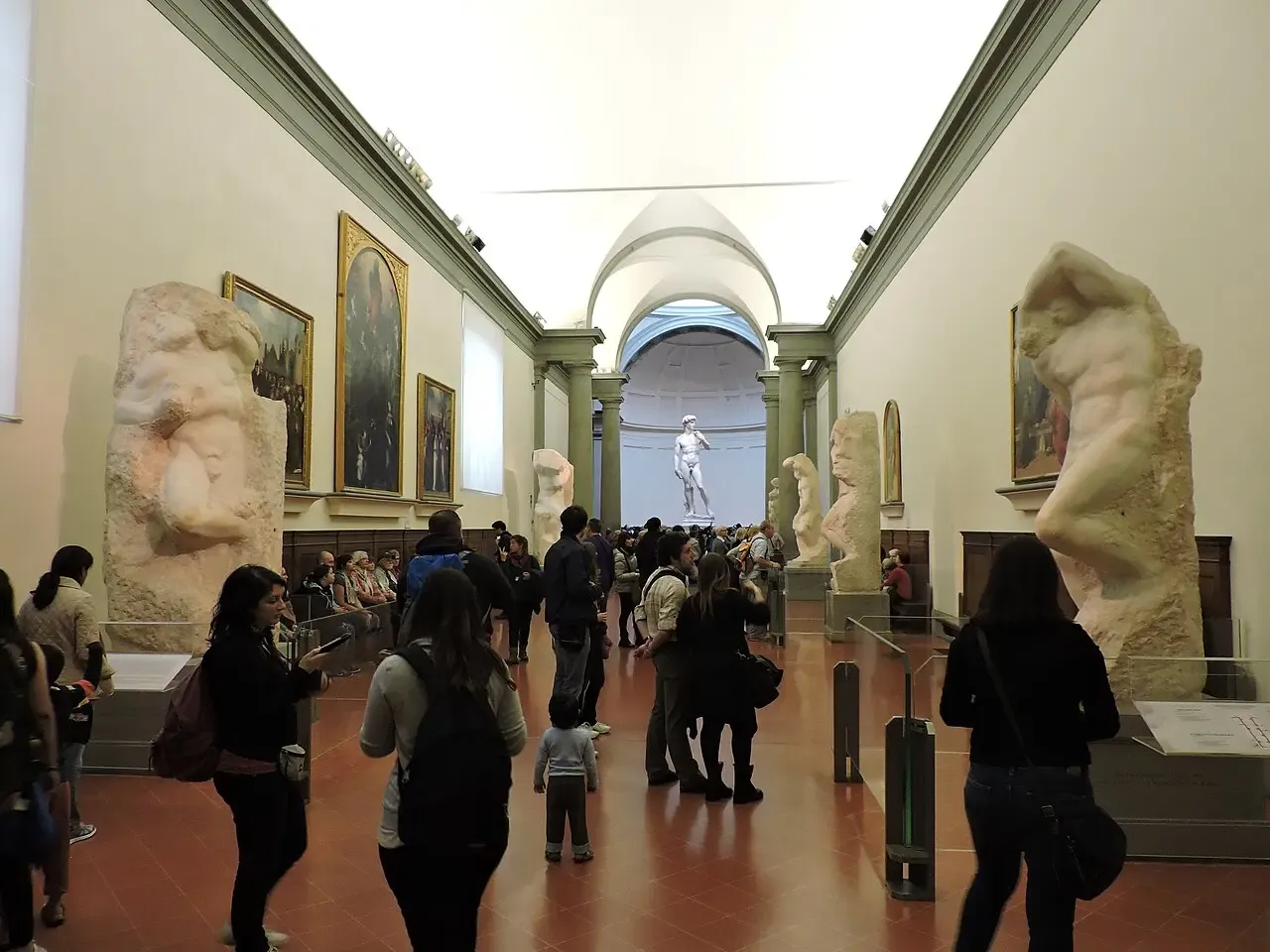
Plan your visit to Accademia Gallery
Accademia Gallery (Galleria dell'Accademia), the Florence museum that houses Michelangelo's David alongside a collection spanning medieval to 19th-century Italian art, takes some planning ahead of a visit. Ground rules and the works worth the most time sit below, everything needed to plan your visit to Accademia Gallery.
Information about your visit to Accademia Gallery?
The points below answer the questions that come up most often before a visit to the Accademia Gallery:
- When is the Accademia Gallery open? The museum receives visitors from Tuesday to Sunday, 08:15 to 18:50, and the ticket office stops selling entries at 18:20.
- How late can visitors stay inside? Closing procedures start at 18:40, ten minutes before the 18:50 closing time, and access to the Musical Instruments rooms and the first-floor galleries stops then, so arriving well before the 18:20 cut-off leaves room for the whole route.
- Which days does the gallery close? The Accademia closes every Monday for maintenance and staff requirements, and it also shuts on 1 January and 25 December.
- How do visitors reach the museum on foot? Visitors staying inside the historic center walk to the museum, since the gallery sits 500 meters from the Duomo, 10 to 15 minutes from Piazza della Signoria and about 1 kilometer from Santa Maria Novella station.
- Which buses stop near the entrance? Autolinee Toscane lines 6, 14, 17, 23, 31 and C1 serve the San Marco Piazza and San Marco Basilica stops a short walk from the entrance, and the T2 tramway also reaches San Marco.
- Can visitors arrive by car? The Limited Traffic Zone (ZTL) keeps unauthorized vehicles out of the surrounding streets, so drivers use garages beyond the zone. Taxis hold permits and drop passengers at stands near the gallery.
- Which hours stay quietest? The first half hour after opening and the stretch after 16:00 draw the smallest crowds, while congestion peaks between 10:00 and 14:00 and runs heaviest from April through October.
- Which days draw fewer visitors? Wednesdays and Thursdays run calmer than the rest of the week, which leaves more room around the sculptures.
- Is the Accademia Gallery accessible? A lift connects the ground floor to every exhibition hall, an accessible restroom sits near the lift, and tactile maps in the Sala del Colosso and on the first floor assist visitors with visual impairments.
- How long does a visit take? Travelers who come only for David finish in about 30 minutes, while a full pass through the collection runs one to two hours. The common average is 90 minutes.
Explore whatever you need in detail
Eleven further pages cover the Accademia Gallery in depth, each one handling a single part of the visit.
Accademia Gallery tickets and general information
One page gathers the Accademia Gallery ticket options together with the essential facts about the museum, including what each entry covers and how the visit itself works.
Accademia Gallery opening hours
Opening times move with the calendar, and late arrivals miss the daily ticket-office cut-off. A separate page sets out the weekly schedule and its exceptions.
How to get to Accademia Gallery
Visitors reach the historic center on foot, by bus, by train or by taxi, and each route carries its own constraints. Each option gets its own walkthrough on the transport page.
Best time to visit Accademia Gallery
Crowd levels shift hour to hour and day to day. The calmest windows for seeing the collection get their own breakdown by time of day and by weekday.
Accademia Gallery dress code
Museum entry rules differ from what Florence's churches demand at the door. One page sets out the Accademia's own requirements and where the confusion starts.
Which Accademia Gallery ticket to choose
Some tickets cover museum admission on its own, while others bundle entry to more Florence sites. A comparison page weighs what each option covers.
Inside Accademia Gallery
The collection reaches well past the Tribune, through the sculpture halls, the Trecento altarpieces and the temporary shows. One page maps the galleries room by room.
Accademia Gallery gift shop
The store at the end of the route sells books, guidebooks and reproductions of the works on display. A shorter page covers what the shop stocks and where it sits.
How to avoid the queue at the Accademia Gallery
Queues at the entrance grow long without a reserved slot. Another page explains how timed entry works and what shortens the wait at the door.
Where the original David stands
Copies of David stand elsewhere in Florence, so plenty of travelers turn up at the wrong address. One page settles where the original marble stands.
How tall Michelangelo's David is
The scale of the statue surprises most people who meet it in person. One more page gives the exact measurements of the sculpture and the pedestal beneath it.
Where is the Accademia Gallery located?
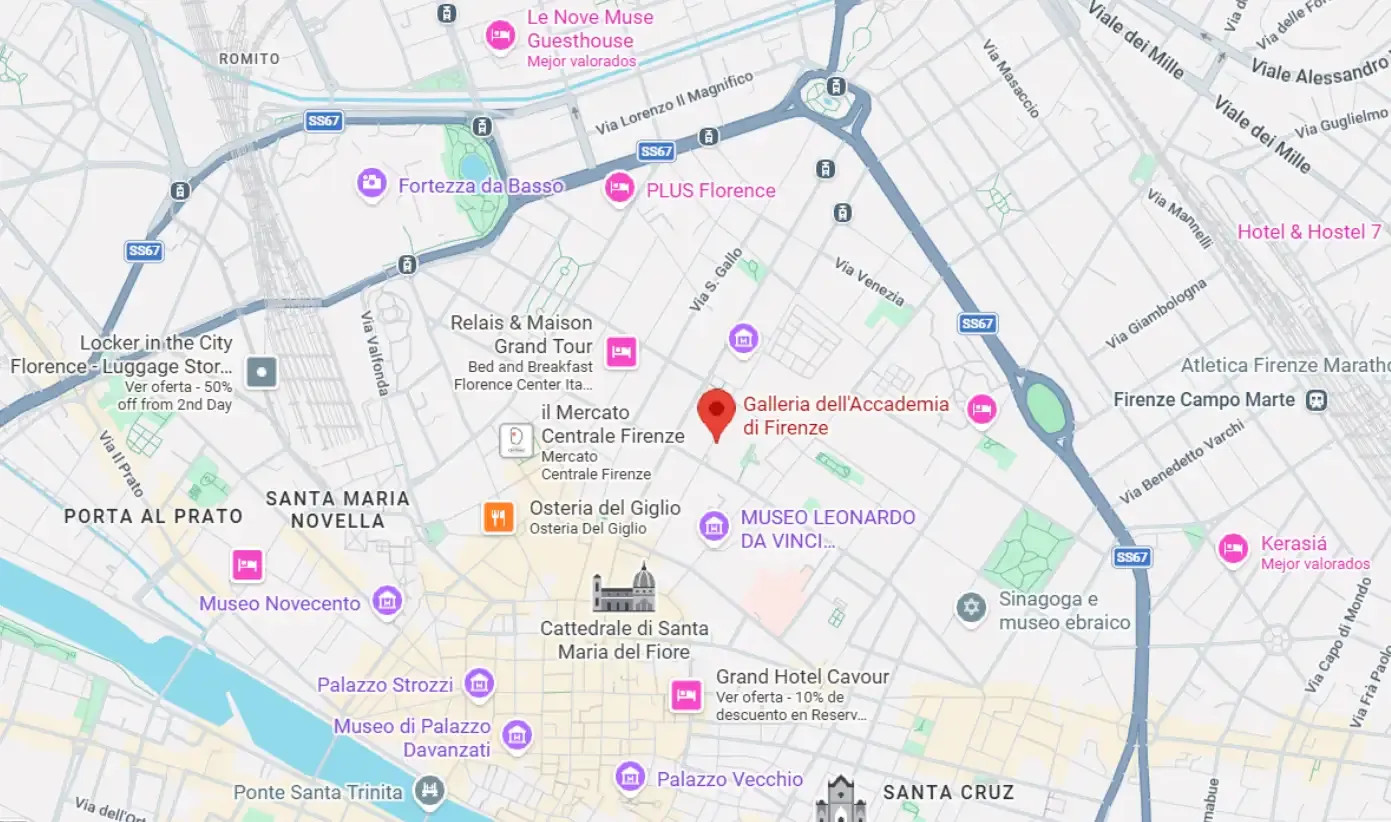
Where is the Accademia Gallery located?
The Accademia Gallery occupies Via Ricasoli 58/60, in the center of Florence. The building stands between the Duomo and Piazza San Marco, which places the museum inside the historic district and within walking distance of the Basilica of San Lorenzo and the University of Florence. Santa Maria Novella railway station sits about 1 kilometer away, and the walk from it threads through the pedestrian zones that cover this part of the city. Cafes and shops line the surrounding streets, so the last stretch before the entrance passes plenty of places to stop for a coffee.
Book your ticket to Accademia Gallery
What to see at Accademia Gallery
The Accademia Gallery owes its reputation to Michelangelo and holds more works by the sculptor than any other museum in the world. David presides over the Tribune at the end of a corridor lined with the four unfinished Prisoners. Around those marbles hang Florentine paintings from the Trecento and the Renaissance, among them panels by Sandro Botticelli, Domenico Ghirlandaio, Paolo Uccello, Jacopo di Cione and Pacino di Bonaguida. Two further departments close the route: the Museum of Musical Instruments, drawn from the Medici and Lorraine collections, and the Gipsoteca Bartolini with its plaster models.
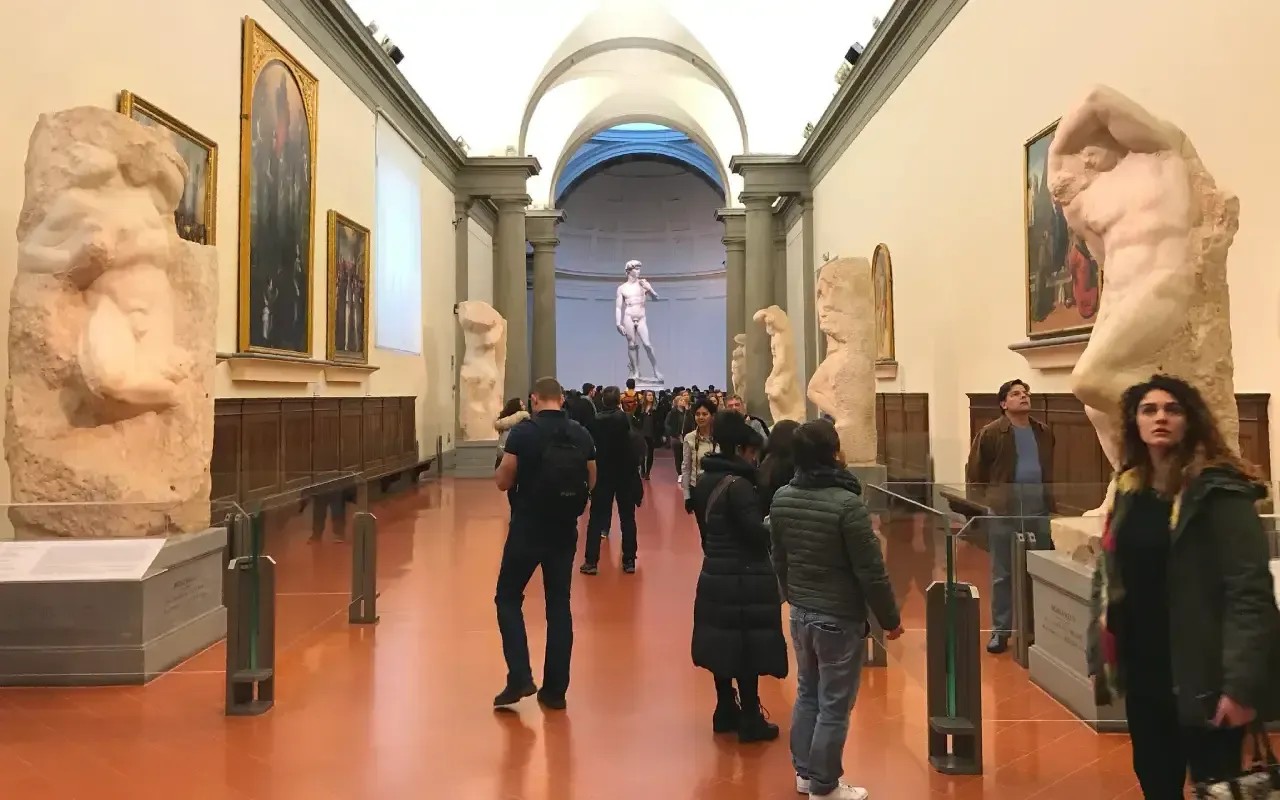
Prisoners Gallery
The Prisoners' Gallery is the corridor that leads to the central tribune of the Galleria dell'Accademia, and four unfinished marble figures by Michelangelo line it. Carved for the tomb of Pope Julius II and left incomplete, the Slaves or Prisoners reached the museum in 1909 from the Grotta del Buontalenti in the Boboli Gardens. Light falling from the ceiling rakes the rough stone, so the bodies appear to twist out of the block in the clearest demonstration of Michelangelo's non finito technique. The line of figures pulls the eye straight to David under the skylit tribune Emilio De Fabris designed, completed in 1882. The corridor takes around 15 minutes to walk.
Michelangelo's David
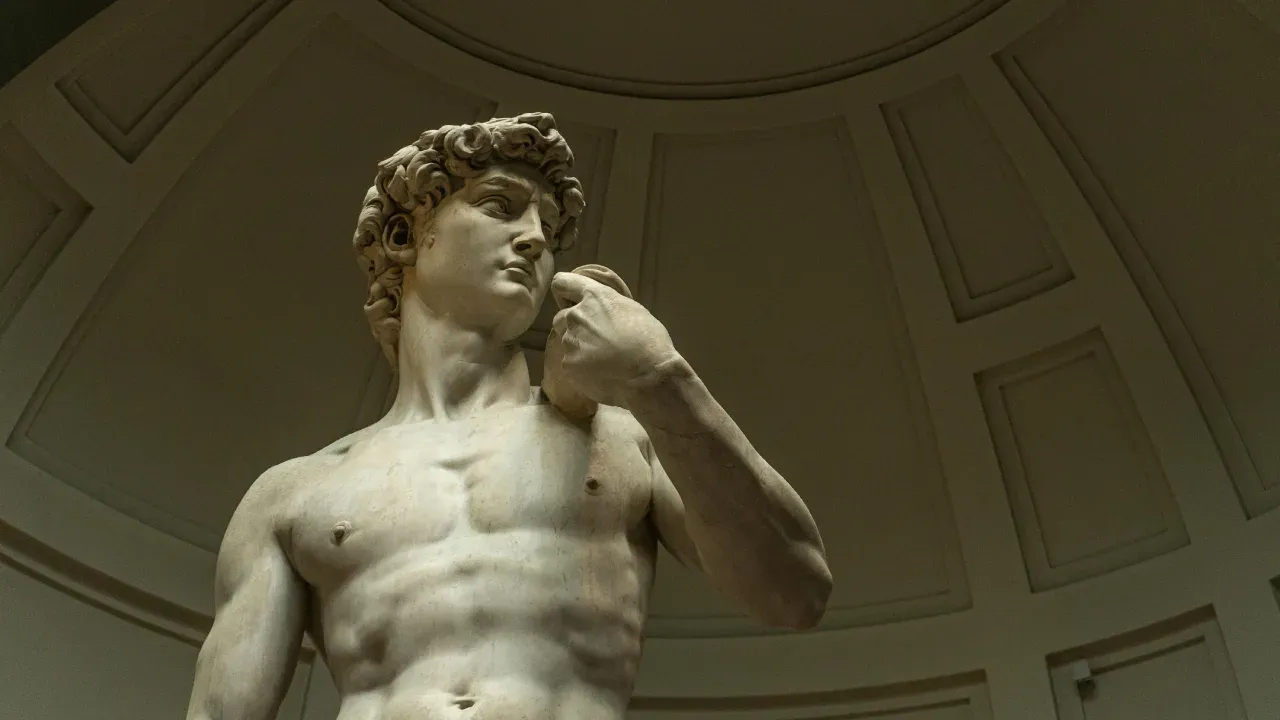
Michelangelo's David
Michelangelo's David stands 5.17 meters tall on a purpose-built pedestal at the end of the gallery, beneath the tribune skylight. Michelangelo carved the figure between 1501 and 1504 from a single block of Carrara marble abandoned by earlier sculptors, and the pose catches the biblical hero in the moment before the fight with Goliath, muscles tensed and expression contemplative. The statue stood in Piazza della Signoria as an emblem of Florentine civic identity until its transfer in 1873, then waited nine years inside a wooden crate while the tribune rose around it. Daylight from above models the marble surface, and the space around the pedestal allows a full walk around the figure. Most visitors spend about twenty minutes here.
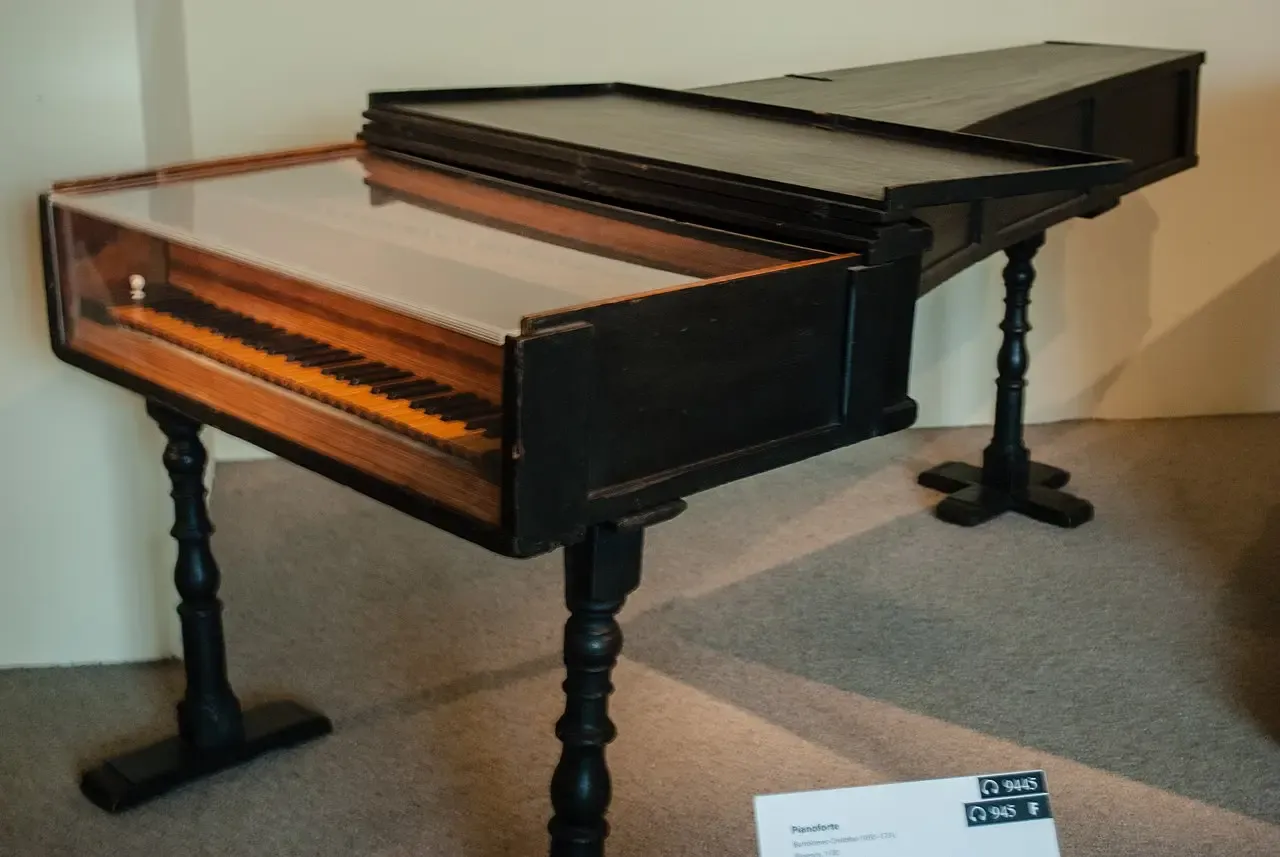
Hall of Musical Instruments
The Hall of Musical Instruments opened in 2001 and holds about fifty pieces from the 17th and 18th centuries, which the Medici and Lorraine grand dukes gathered and the museum keeps alongside the collection of the Luigi Cherubini Music Conservatory. Three rooms carry the display, which includes a 17th-century cello by Niccolò Amati and three instruments by Antonio Stradivari, among them the tenor viola and the cello made in 1690 for Grand Prince Ferdinando of Tuscany. A further room follows the birth of the piano around a spinet built in 1690 by Bartolomeo Cristofori, the maker who invented the piano mechanism. The three rooms take fifteen to twenty minutes to work through.
Gipsoteca Bartolini
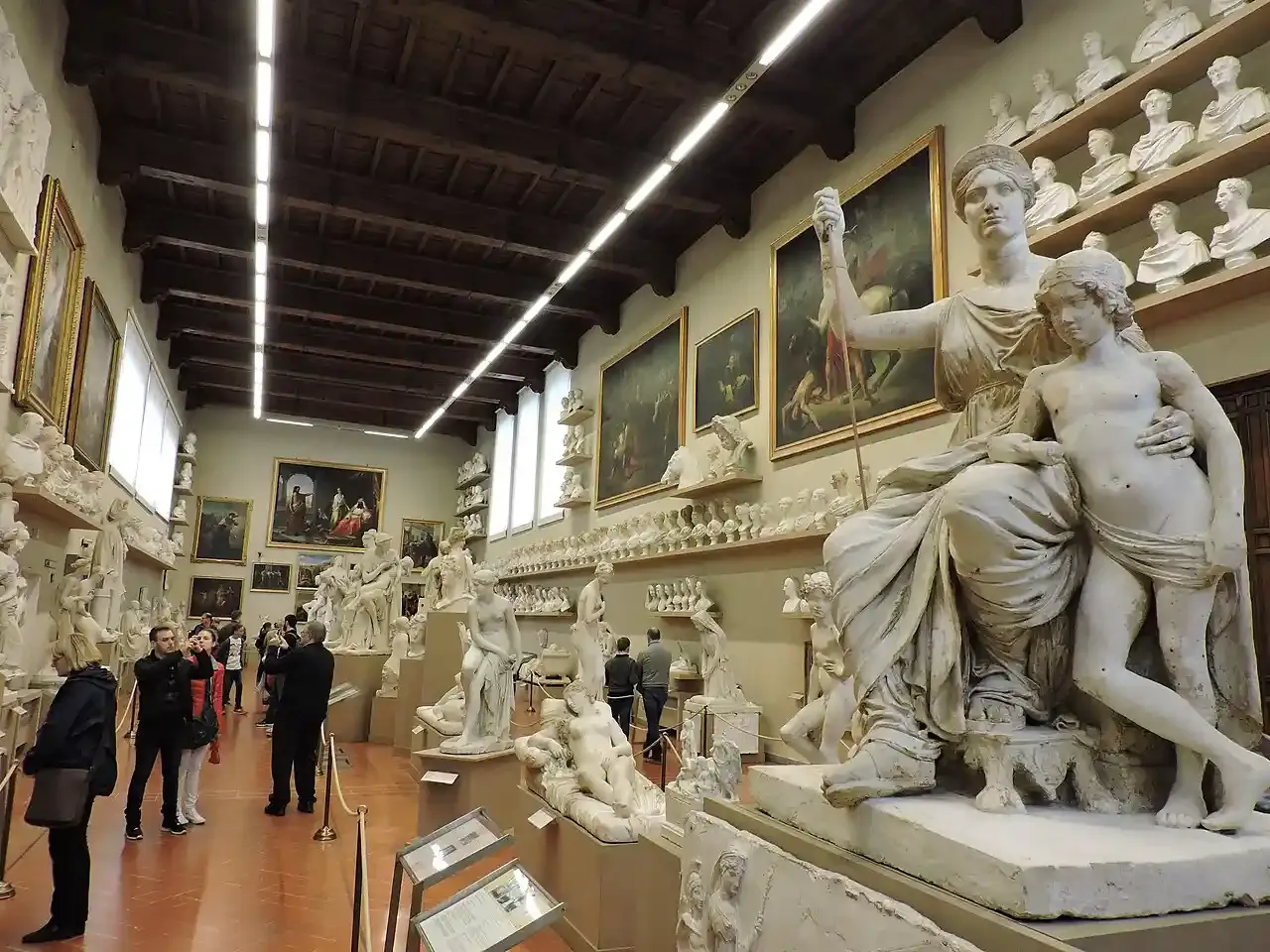
Gipsoteca Bartolini
The Gipsoteca Bartolini fills the Salone dell'Ottocento with more than ninety plaster models by Lorenzo Bartolini, the 19th-century sculptor who taught at the Academy, shown alongside work by his pupil Luigi Pampaloni and the paintings of the same century. The room recreates a working studio, because sculptors relied on these casts to fix form and proportion before cutting anything permanent, and the casts include portrait busts and full-scale models for tombs and public commissions. Mold lines, tool marks and structural supports stay visible across the white surfaces, which makes the mechanics of 19th-century sculpture easy to follow. A pass through the hall runs ten to fifteen minutes.
Tips for visiting Accademia Gallery
The Accademia enforces a short list of house rules at the entrance.
- Booking a timed entry ahead matters, since same-day admission is the exception.
- Bags cannot exceed 40 by 30 by 18 centimeters, and the museum runs no cloakroom, so luggage, large backpacks and helmets stay out. The official site points to a luggage deposit at the MyAccademia store on Via Ricasoli, worth confirming ahead rather than counting on.
- Everything passes a metal detector, and knives, scissors, blades and anything judged dangerous are refused at the door. The museum will not store them.
- Photography without flash is fine for personal use, while selfie sticks, bulky tripods and drones are not, and phones must stay off or on silent.
- Water in plastic bottles up to half a liter comes in, other drinks do not, and eating anywhere inside is prohibited. Umbrellas that do not fold are refused, and the rest go in the stands at the entrance.
- The route runs one way toward David, while the Gipsoteca and the instrument rooms leave more room to slow down.
- Audio guides cover the collection in English, Italian, French, German and Spanish, and taking one requires leaving an identity document at the bookshop.